Going backwards to go forward
Perth NRL team a no-brainer...but who's to blame for delay?

Tens of thousands of rugby league supporters will flock to Perth Stadium today to soak up the blood, sweat and atmosphere of a NRL double-header showcasing the brutal sport to a new and potentially lucrative audience.
It will foreshadow the State of Origin match in June when a near record crowd is expected to underline the local interest in a sport that is undergoing the most shambolic transition towards national status.
The N in NRL surely stands for Nearly rather than National.
Many people brought up on the other football code are lost on the subtleties of a game in which chucking the ball backwards and running into human brick walls are considered essential skills.
Yet there is no question that the physicality and intensity of rugby league, and the rawness and passion of its participants, make it one of the most compelling sports to watch.
Its 180-degree format certainly makes it ideal as a television product while Perth Stadium, despite its oval playing surface, is configured superbly for a rectangular event.
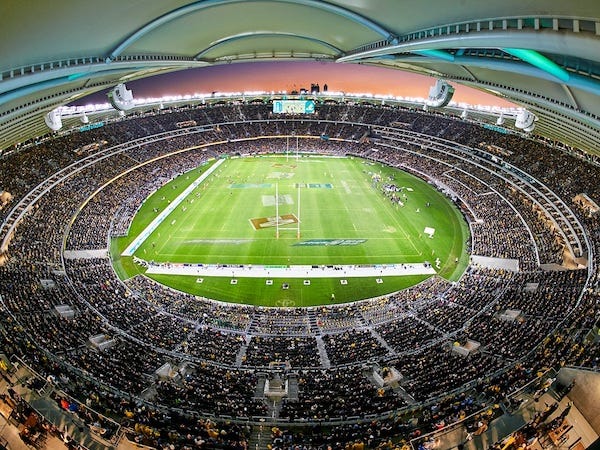
Perth Stadium converts seamlessly to host rugby league.
That is partly why State of Origin opponents NSW and Queensland are this year likely to play in front of just the third sporting crowd in WA history to reach 60,000 people.
The record was set a year after the stadium opened in 2018 when Australia produced a rare Bledisloe Cup win over New Zealand in front of 61,241 spectators.
Two years later, Melbourne broke a long premiership drought in an exhilarating AFL grand final against the Western Bulldogs with 61,118 people as witnesses.
Yet for all the interest in rugby league in WA, which makes it a no-brainer to expand the league west to the best stadium and richest market in the country, greed and myopia appear to have killed off the prospect of a frontier franchise in Perth.
The blame is difficult to ascertain, and probably even irrelevant.
Premier Roger Cook, an avowed rugby league supporter despite growing up in football heartland in Claremont and attending footy factory Scotch College, was exceptionally bullish about a Perth team last year before getting cold feet in more recent times.
He spoke of the code’s “strong support and huge potential for growth”, referred to the NRL as “magic” and underlined Perth fans “historically developing a strong connection with our visiting
‘home’ teams”.
“As a passionate rugby league fan, I’ve long been an advocate for NRL in WA,” he said.
His messaging could not have been clearer if he was looking to set the scene for the NRL to replicate virtually every other major sport by building or relocating a team on the west coast.
If a team can be based in third world Papua New Guinea, where an unnamed NRL newcomer will be launched in Port Moresby in 2028, surely a Perth presence makes even greater economic and sporting sense?
“The new team will belong to the people of Papua New Guinea,” prime minister Anthony Albanese said last December. “It will call Port Moresby home.”
What a Christmas present he then provided to the NRL with the Australian government chipping in $600million to swell the coffers already bulging from PNG’s $150m seed capital.
While Pacific realpolitik requires Australia’s nearest northern neighbour to be kept close to the bosom rather than be allowed to gravitate towards China, sporting logic suggests that WA is a far better national option than a push off-shore.
While Cook had crystal clear interest in a Perth team a year ago, it is far less transparent why the development has hit a wall bigger than the front rows to be fielded by Cronulla and South Sydney tonight.
He blamed the NRL for demanding too high a price of admission, saying WA was being treated as a “cash cow”.
NRL chairman Peter V’Landys had previously urged the WA government to move swiftly if they wanted a team to come to town.
Brinkmanship may be part of V’Landys’ negotiating strategy but his league is in a position of relative strength and able to demand a substantial entry fee.
If was not the case in 1986 when the bankrupt VFL turned to WA and Queensland to bankroll its floundering league.
WA football has been propping up Victoria ever since, starting from their very first days when it paid
a $4million licence for West Coast to enter the league and added another $4million to the VFL’s kick with draconian transfer fees for the players who wanted to move home.
If only impatient WA had done what South Australia did by waiting for several more years to make their own move into the league at a far more palatable price.
Perhaps the VFL would have been rationalised into a far leaner model without some of the mendicant Melbourne teams who remain a drain on the game.
Maybe that is Cook’s strategy, after all.
Wait long enough and V’Landys and his rugby league cohort will come begging.
It doesn’t appear a plausible strategy but maybe Cook thinks that any sport that moves the ball backwards might have different rules when it comes to expansion.