Greed driving BBL anguish
And selecting a North star

Greed and hypocrisy often go hand in hand which makes it unsurprising the various reactions to the failure to privatise Australian cricket’s Big Bash League.
For those not in the know, Cricket Australia has been looking at ways to flog all or parts of the franchises that comprise its domestic Twenty20 league.
“We need to sell the BBL so we can afford to get better players to play in it,” a highly influential cricket administrator told me recently. Say what?
It is not the first time this has happened.
A $30million offer for the Perth Scorchers was made a decade or so ago but disquiet at the deal, even with it being driven strongly from within the then WA Cricket Association, meant it did not get off the ground.
The official motivation for revisiting the concept is that CA needs to sell off its prime asset to balance its budget.
It is a strategy as far-sighted as building a successful poultry business and then hiving it off to a family of foxes.
It might be colourful and newsworthy in the initial stages but will leave a considerable mess and little value by the time commonsense returns.
And it is at odds with the clear-sighted analysis of Andrew Jones, once the NSW chief executive and CA strategic manager tasked with forecasting the sport’s future needs.
“Finance 101 says an operating deficit is not fixed by selling a capital asset,” he said.
“It is fixed by increasing revenue or cutting costs.”
The most bitter reaction to the collapse of the BBL sale came from those who would benefit most from it – the multi-millionaire players seeking even bigger returns for their high-octane slogging.
They would automatically get 27.5% of the sale under their current revenue-sharing deal and would like a fair bit more than that.
The players at the very pointy end of this landscape know they are in a seller’s market and want a big chunk of the pie.
But how much money do they need?
Australian captain Pat Cummins is about to start a CA deal that will pay him $4million a year to represent his country.
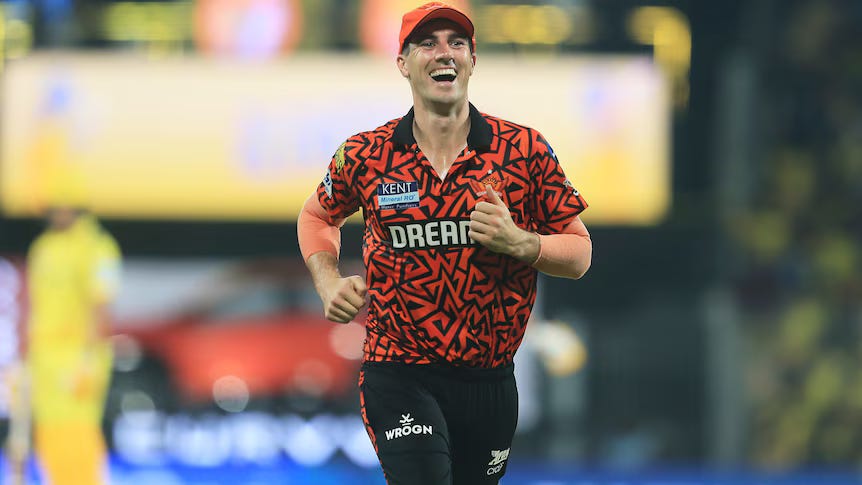
Pat Cummins is about to be paid $4million a year to remain loyal to Australia.
The deal is designed to compensate him for his loyalty in forgoing the riches on offer in the various T20 leagues around the world.
He underlined the dilemma recently when he identified how some players, probably not more than a handful, would be penalised by choosing to play in a Test series against Bangladesh rather than the lucrative Hundred series in the UK.
“Some of our guys are saying no to half a million pounds for 20 days’ work to go and play those two Test matches against Bangladesh,” Cummins moaned. “It is a tension point.”
This is a player who CA paid $1million a year for half a decade when a chronic back injury meant he was unable to bowl a ball for his country. Grateful much?
Cummins is the same player being paid handsomely to remain loyal to his country yet opting to stay in the IPL this month rather than play for Australia in an imminent one-day series against Pakistan.
How much money does Cummins need to find satisfaction in his career?
He is a star, one of the best ever exponents in a sport that carries enormous cultural and social weight in his country.
Yet an income approaching eight figures a year does not appear to be enough.
Dennis Lillee, like Cummins a charismatic fast bowler and game-changing player who drew supporters and sponsors to the sport, was paid $7500 in the year before World Series Cricket started in response to the pittance afforded to the game’s prime players.
That revolution was driven by the need to earn a living wage; this one appears to be is inspired by insatiable greed.
Selecting a North star
Marcus North is about to become England’s primary cricket selector and one of the most influential people in world cricket.
It is a fair climb for a young Perth kid whose father Peter used to throw balls for him for hours after school every night and later, had a fairytale rise and fall as a Test cricketer.
My first match as a senior cricket writer was North’s debut for WA and I followed his eventful career from close range for nearly two decades.
That included writing a weekly column with him during the 2009 Ashes series, which gave the readers a riveting fly-on-the-wall view of the Australian rooms until he was asked to tone down the candour, and a first-hand account of a chat with Prince Philip at Lord’s that also had to be trimmed before publication.
Pointing to the VB logo on North’s shirt, Phil asked: “That wouldn’t be for a beer, would it?”
Answering in the affirmative, North was then asked how the brewery could keep up with the supply required for an Australian cricket team given everyone knew that they drank heavily and often.
The overwhelming memory was from a match at UWA’s James Oval in the mid-1990s, when Marcus was a tall, gangly but supremely-gifted 15-year-old at Kent Street Senior High.
I bowled from the southern end and Marcus, standing on his toes and driving off the back foot with the high hands that were his trademark, struck the delivery over cover-point onto the second storey of the Social Science building.
It was a remarkable stroke, almost unimaginable unless you were there to see it, and announced him as a player to watch.
Nearly two decades later, we were having dinner in Durban during the Scorchers’ ill-fated Champion’s League tour, when we both looked up at the same time after looking at the red wine list.
“That can’t be true,” Marcus exclaimed as we both checked the same section of the menu.
It was. A bottle of 1998 Grange Hermitage was for sale.
The exchange rate at the time was about 10 rand to the dollar and the Grange was priced at about 300 rand.
We could not order quickly enough.
North’s choices might be a bit harder these days but he will still move swiftly if he encounters a champion selection, particularly if it comes at a bargain price.
Hope they had a few bottles of the Grange on sale that night